

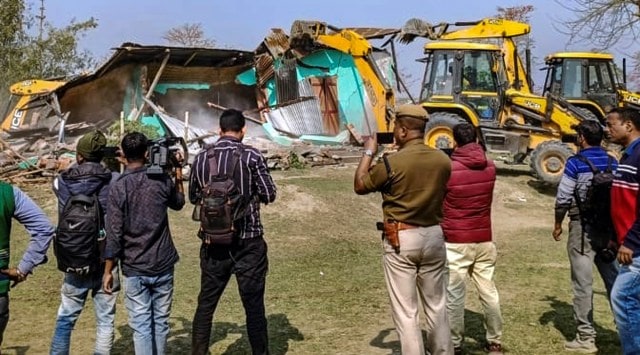
Assam evictions have sparked a significant crisis, driving thousands of families into homelessness and despair. These drastic measures, portrayed by the BJP government as necessary actions against unlawful encroachment, have left many residents questioning their validity, as they possess documents proving their rightful ownership of the land. The ongoing evictions are further complicated by rising Islamophobia in Assam, particularly affecting Bengali-speaking Muslims who are targeted amid the government’s anti-Bangladeshi migrant narrative. With families facing sudden dislocation, the implications of this policy extend beyond mere housing; they threaten social cohesion and erode trust within communities. As more voices call for justice and accountability, the devastating impact of these evictions continues to echo throughout Assam’s landscape.
The forced displacements occurring in Assam are part of a broader narrative that underscores the plight of countless individuals uprooted from their homes. Often labeled as illegal settlers, many of these citizens have established deep roots in their communities, only to find themselves facing aggressive government policies aimed at creating a more homogeneous society. As the state’s leadership targets specific demographics under the guise of enforcing land laws, the stigma surrounding them is intensified, leading to widespread homelessness. This graphic display of governmental authority sheds light on the ongoing issues surrounding migration and identity in India, complicating the already strained relationships between various groups. Ultimately, the situation highlights not just the immediate need for shelter, but also a pressing requirement for societal understanding and empathy amidst growing tensions.
The Impact of Assam Evictions on Families
The recent evictions in Assam have resulted in devastating consequences for countless families, many of whom are now facing homelessness and uncertainty. Reports suggest that entire communities have been uprooted, as government actions seeking to address illegal encroachment disproportionately affect those with longstanding ties to the land. Families who have cultivated and lived on these plots for generations are suddenly rendered landless, leading to a crisis of security and stability that poses a significant challenge for local authorities and humanitarian organizations.
Not only are these families facing immediate displacement, but the loss of housing also brings forth a myriad of secondary issues, such as access to education and healthcare. Many affected individuals are struggling to find temporary accommodations, and their prospects of rebuilding their lives remain bleak. With the probable loss of livelihoods, there is an urgent need for government intervention to aid those displaced by these aggressive eviction policies that have left thousands vulnerable.
Frequently Asked Questions
What are the recent developments regarding Assam evictions and homelessness?
Recent Assam evictions have led to thousands of families becoming homeless, with the BJP government’s policies framing these actions as anti-encroachment measures. Many evicted families claim long-standing ties to the land and valid documentation.
How do BJP government policies impact Assamese families and their stability?
BJP government policies, particularly around Assam evictions, have significantly disrupted the stability of Assamese families. Many are facing displacement and homelessness, raising concerns about their rights and livelihoods on ancestral land.
What role does Islamophobia play in the context of Assam evictions?
Islamophobia has intensified alongside Assam evictions, notably affecting Bengali-speaking Muslims. The rhetoric from state leadership suggests targeted removals that exacerbate community tensions, contributing to a climate of fear and instability.
How do allegations of illegal Bangladeshi migration relate to Assam evictions?
Allegations of illegal Bangladeshi migrants in India serve as a justification for many Assam evictions, according to the BJP government. However, many affected individuals assert their long-term residency and legal rights to live on their land.
What are the long-term consequences for families displaced by Assam evictions?
Families displaced by Assam evictions face significant long-term consequences, including the loss of homes and property, disruption of community ties, and challenges in accessing social services. The strain on their livelihoods contributes to an ongoing crisis of homelessness in the region.
How has public discourse shifted regarding family displacement in Assam following the evictions?
Public discourse surrounding family displacement in Assam has shifted dramatically, with a growing recognition of the human impact of evictions. Activists and NGOs are increasingly highlighting issues of rights, homelessness, and the need for humanitarian assistance.
What documentation is typically held by families affected by Assam evictions?
Families affected by Assam evictions often possess various types of documentation, including land ownership papers and government identification, which they claim validate their long-standing ties to the land they occupy.
What actions are being taken to support those affected by evictions in Assam?
In response to the crisis of homelessness resulting from Assam evictions, various NGOs and activists are mobilizing to provide humanitarian aid, legal support, and advocacy to help displaced families regain their rights and rebuild their lives.
| Key Points |
|---|
| The evictions in Assam have left thousands of families homeless. |
| The BJP government claims these actions are against illegal encroachment. |
| Many affected families argue they have historical ties to their land and possess documentation. |
| The situation reflects a rising climate of Islamophobia, particularly targeting Bengali-speaking Muslims. |
| The state’s chief minister has vowed to remove Bangladeshi migrants as part of this crackdown. |
Summary
Assam evictions have resulted in widespread devastation, displacing thousands of families who are now living in precarious conditions. The conflict surrounding these evictions exposes deep-rooted issues regarding land ownership, illegal encroachment, and the impact of political rhetoric on marginalized communities. While the government positions these actions as necessary, many individuals believe their long-standing residency and connection to their land are being disregarded. The situation has magnified social tensions, particularly against Bengali-speaking Muslims, sparking concerns over the motivations and implications of such evictions. Overall, the situation calls for urgent attention and compassionate responses to the plight of those affected.



























