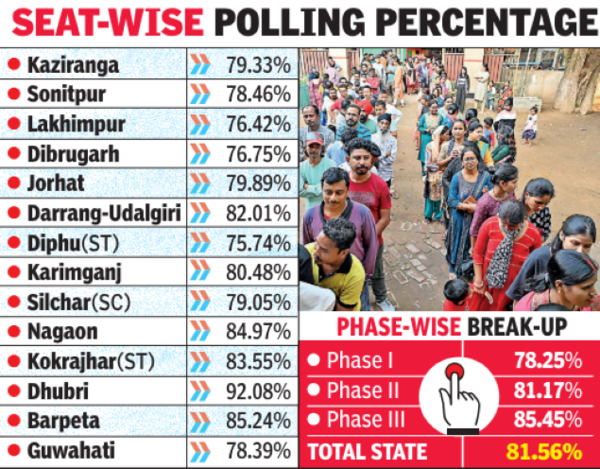
Guwahati voter turnout has reached an impressive milestone in Assam’s democratic landscape, especially during the highly anticipated 2026 Assembly elections. This event witnessed a remarkable overall voter turnout of 85.91 percent, a number that stands among the highest in the state’s electoral history. Notably, women have taken a larger role in shaping the political narrative by achieving a female voter turnout of 86.50 percent, surpassing their male counterparts, who recorded 85.33 percent. Such statistics not only reflect a shift in voter dynamics but also highlight the increasing political engagement of women in the region, bridging the long-standing gender gap in voting. The rise in women’s participation signals a significant transformation in the attitudes surrounding women in politics, paving the way for a more equitable representation in the state’s electoral processes.
In the vibrant city of Guwahati, the phenomenon of voter turnout showcases a new era of participation in the political arena during the 2026 Assam Assembly elections. With a striking turnout of 85.91 percent, this event marks a pivotal moment in the state’s electoral history, where engagement levels have soared. Women now play a crucial role in the electorate, demonstrated by their astonishing 86.50 percent turnout, which surpasses that of men, who participated at 85.33 percent. This progressive shift not only signifies enhanced voter turnout statistics but also addresses the historical gender gap that has often hindered women’s political involvement. Enhanced electoral infrastructure and awareness campaigns have likely contributed to this newfound political engagement, establishing a more inclusive democracy in Assam.
Guwahati Voter Turnout: A Historic Milestone
The 2026 Assam Assembly elections marked a pivotal moment in the state’s democratic narrative, achieving a record voter turnout of 85.91 percent. This impressive statistic reflects not only the enthusiasm of the electorate but also the continued commitment to political engagement within the community. Guwahati, being the state’s capital and a burgeoning urban center, played a significant role in this achievement. The willingness of citizens to engage actively in the electoral process demonstrates a shift towards greater civic responsibility and awareness, signaling a robust democratic ethos that could influence future elections.
This historic voter turnout is particularly noteworthy when viewed in the context of women’s increasing participation in elections. Female voters turned out at an astounding 86.50 percent, surpassing their male counterparts, who voted at 85.33 percent. This trend is a reassuring indicator of changing attitudes toward gender equality within the political sphere in Assam. The rise in women’s participation reflects ongoing efforts to empower women through political engagement, ensuring that their voices are heard and considered in the democratic process.
Trends in Women’s Participation in Assam Elections
The participation of women in the 2026 Assembly elections marks a significant turnaround from previous decades characterized by a substantial gender gap in voting behaviors. Historically, women’s turnout was often overshadowed by men’s, with the 1962 Lok Sabha elections exemplifying this trend—where male participation was recorded at 58.39 percent compared to just 42.05 percent for females. The current landscape, however, paints a contrasting picture, showcasing women’s rising political engagement and active involvement in shaping their electoral destinies. This evolution is crucial not only for gender equity but also for the overall health of Assam’s democracy.
The factors contributing to this surge in women’s voter turnout are multifaceted. Key among them are improved electoral infrastructure, which has made voting more accessible, and ongoing voter awareness campaigns that have specifically targeted women. Additionally, socio-political changes, including educational advancements and community empowerment initiatives, have fostered an environment where women are encouraged to participate actively in the political arena. The increased visibility of women in leadership roles further inspires confidence, breaking down historical barriers to their electoral engagement.
Understanding Voter Turnout Statistics in Assam
Analyzing voter turnout statistics in Assam reveals significant insights into the dynamics of electoral participation. Over the years, Assam’s voter turnout has seen a remarkable upward trajectory—from a mere 47.54 percent in the 1951 elections to consistently surpassing the 80 percent mark in recent elections. This steady rise underscores a growing political consciousness among the electorate and reflects broader societal changes that encourage inclusive participation in the democratic process. Such statistics present a compelling narrative of a state grappling with its past but moving towards a more participatory future.
Moreover, these statistics highlight a more inclusive electoral landscape where the gap between male and female voters has progressively shrunk. The 2026 elections, with female voter turnout exceeding that of men, showcase a significant shift in the political arena. This trend indicates that women’s voices are not only being heard but are also becoming a formidable force driving electoral outcomes and shaping policies. This transition is crucial for fostering a balanced approach to governance and ensuring that women’s perspectives are integral to Assam’s political framework.
The Gender Gap in Voting: A Closer Look
The gender gap in voting has long been a focal point of electoral studies, especially in Assam. Historically, men have dominated voter turnout figures, reflecting entrenched societal norms that limited women’s political agency. However, recent elections signify a notable shift, particularly evident in the 2026 Assam Assembly elections, where women not only caught up but surpassed men in terms of participation. This significant reduction in the gender gap is a powerful indicator of shifting attitudes and increased efforts towards women’s empowerment in the political landscape.
The narrowing gap in voter turnout statistics is indicative of broader societal changes, including enhanced women’s political engagement and the eradication of barriers that have traditionally hindered their participation. Programs aimed at sensitizing communities about the importance of voting, particularly among women, have effectively mobilized this demographic. With women constituting a crucial segment of the electorate, their stepped-up participation heralds a more balanced representation in political decisions affecting Assam’s future.
Political Engagement of Women in Assam
The political engagement of women in Assam is witnessing a transformative phase, particularly highlighted by the turnout figures from the 2026 Assembly elections. Women’s participation has increased steadily over the years, reflecting both changing societal norms and proactive initiatives aimed at empowering women politically. The record female turnout of 86.50 percent is emblematic of this growing engagement, showcasing women’s determination to assert their rights and influence the political landscape. Such engagement not only enhances the democratic process but also ensures that women’s issues are at the forefront of political agendas.
Efforts to bolster women’s participation extend beyond voting. Initiatives aimed at educating and empowering women to take on leadership roles within their communities have begun to pay significant dividends. This shift in political engagement demonstrates a collective acknowledgment of the importance of diverse perspectives in governance. With increasing numbers of women stepping into roles as candidates, advocates, and active voters, Assam is poised for a future where the voices and needs of all citizens are represented and addressed in the political sphere.
Frequently Asked Questions
What were the voter turnout statistics for Guwahati in the Assam Assembly elections 2026?
In the Assam Assembly elections 2026, Guwahati recorded an impressive overall voter turnout of 85.91 percent. Notably, women’s participation in these elections surpassed that of men, with a female voter turnout of 86.50 percent compared to 85.33 percent for male voters. This trend reflects a significant increase in political engagement of women in Guwahati and marks a pivotal shift in the gender gap in voting within the state.
| Key Point | Details |
|---|---|
| Guwahati Voter Turnout Rate | 85.91% overall, with female turnout at 86.50% and male at 85.33%. |
| Historical Context | Voter turnout was significantly lower in the past, e.g., 47.54% in 1951 and male turnout exceeding female until recently. |
| Women Empowerment | Women’s participation in elections has increased, showing a consistent upwards trend with 82.01% in 2021 surpassing men. |
| Factors for Increased Turnout | Improved electoral infrastructure, voter awareness campaigns, and socio-political changes fostering women’s participation. |
Summary
Guwahati voter turnout has reached impressive heights in recent elections, showcasing a pivotal shift in electoral participation, especially among women. The record turnout of 85.91% in the 2026 Assembly elections marks a significant achievement in Assam’s democratic landscape. Women not only matched but surpassed male voter participation, reflecting broader socio-political changes and successful outreach efforts that empower female voters. The historical context of turnout, which was once characterized by a marked gender gap, now highlights a more inclusive democratic process, as women continue to rise as influential participants in shaping the political future of Assam. As voter turnout remains robust, the trend signifies a progressive shift towards equality in electoral engagement.