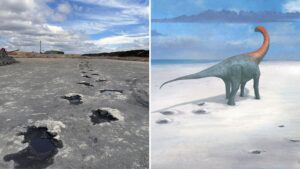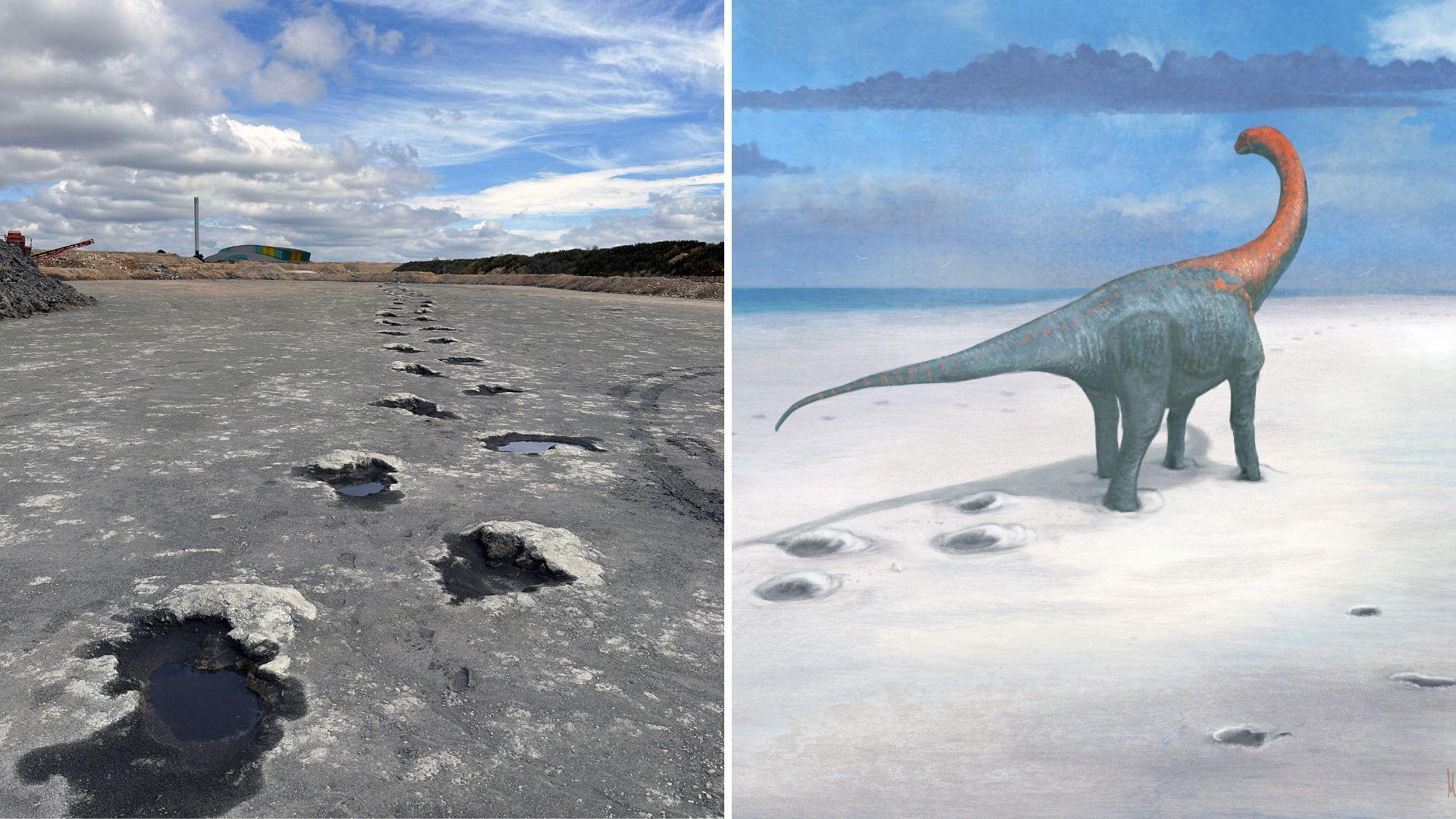
Jurassic dinosaur footprints have emerged as a remarkable window into a prehistoric world, unveiling the behaviors and paths of these magnificent creatures that roamed the Earth over 166 million years ago. Recent discoveries in an Oxfordshire quarry have revealed hundreds of fossilized footprints, providing a rare glimpse into the lives of Jurassic animals in a land once dominated by lush vegetation and shallow lagoons. These trackways showcase the interactions between colossal herbivores and formidable predators, sparking excitement in the field of dinosaur behavior research. As paleontologists meticulously study these prints, the opportunity to answer pivotal questions about dinosaur movement and social structures is within reach. This extraordinary find underscores the importance of Oxfordshire as a significant site for understanding dinosaur discoveries and their habitats during the Jurassic period.
The recent unearthing of ancient dinosaur tracks in Oxfordshire has captured the imagination of paleontologists and enthusiasts alike. These remarkable impressions, remnants of a bygone era, shed light on the intricate lives of ancient reptiles, providing insights into their movement patterns and social behavior. At the Oxfordshire quarry, layers of sediment have concealed these precious fossilized traces, now revealing a profound story from the Jurassic epoch. Researchers are eager to delve into how these prehistoric species interacted with each other and their environment, paving the way for advancements in dinosaur behavior studies. The significance of such findings cannot be understated as they contribute richly to our understanding of the ecological dynamics that ruled the landscape millions of years ago.
Exploring Jurassic Dinosaur Footprints in Oxfordshire
The recent discovery of fossilized footprints in an Oxfordshire quarry has opened a fascinating window into the past, offering a glimpse of the Jurassic period’s vibrant ecosystem. These impressions, dating back around 166 million years, belong to a range of significant dinosaurs that thrived in a landscape very different from our present-day view of the English countryside. Housed beneath layers of clay, these delicate footprints paint a vivid picture of life in a time when plant-eating dinosaurs roamed alongside fearsome predators, revealing insights into their movements and interactions in a warm, shallow lagoon habitat.
Each footprint serves as a record of dinosaur behavior and activity, illuminating how these enormous creatures interacted with their environment. Researchers believe that such fossilized footprints are invaluable for understanding ancient animal behavior, migration patterns, and ecological dynamics. By studying the unique stride and depths of these prints, scientists can gain insights into the agility and social structures of these Jurassic animals, contributing to the broader narrative of dinosaur evolution and their adaptations throughout history.
Significance of Dinosaur Discoveries in Oxfordshire
The Oxfordshire quarry has become a monumental site for dinosaur discoveries, marking it as one of the most significant paleontological locations in Britain in recent decades. The layers of sediment revealing these fossilized footprints provide context not only for the dinosaurs themselves but also for the environmental conditions they faced. This geological backdrop allows scientists to piece together a comprehensive picture of how climate and geography influenced the lives of these ancient creatures, further enriching our understanding of their evolution.
These discoveries also emphasize the continuous importance of fossil research in uncovering the narratives of Earth’s biological past. The Oxfordshire findings add to a growing body of evidence regarding the diversity of Jurassic creatures, showcasing how the region served as a thriving habitat for a variety of dinosaur species. This burgeoning knowledge presents opportunities for future research, potentially leading to more discoveries that will enhance our understanding of prehistoric life.
Insights from Jurassic Dinosaur Footprints
Jurassic dinosaur footprints are a key resource for scientists studying the behavior and ecology of these ancient reptiles. These prints not only document the presence of various species but also hint at their behaviors, such as foraging, nesting, and social interactions. As paleontologists analyze the orientation and spacing of these footprints, they can infer movement patterns and herd dynamics, which are critical for understanding how these animals lived and thrived in their habitats.
Furthermore, the preservation of such footprints allows for a detailed examination of locomotion and biomechanical adaptations. Researchers can compare the footprints of different dinosaur species found in Oxfordshire to understand variations in size, speed, and movement styles, shedding light on how these creatures adapted to their environments. By creating detailed digital models of the footprints, scientists aim to generate a database that will assist in behavior research over the coming years, revealing the complexities of Jurassic ecosystems.
The Jurassic Era and its Biodiversity
The Jurassic period, spanning from approximately 201 to 145 million years ago, was a time of dynamic evolution and biodiversity. During this era, dinosaurs flourished, along with a multitude of other life forms, including marine reptiles, flying pterosaurs, and expansive flora. The warm and humid climate fostered lush vegetation, creating ideal conditions for large herbivorous dinosaurs to thrive, which contrasted starkly with the predator species that hunted them.
In Oxfordshire, the landscape during the Jurassic was characterized by coastal lagoons and rich ecosystems that supported diverse dinosaur species. This biodiversity is evident from the fossil record, which showcases various species that adapted to different ecological niches. The layers of rock and sediment in the region capture the interactions between these diverse species, providing researchers with a unique opportunity to explore the evolutionary trajectories of Jurassic life.
How Fossilized Footprints Shape Our Understanding of Dinosaurs
Fossilized footprints are crucial to our understanding of dinosaurs, as they offer unique evidence of life long before the existence of skeletal remains. These tracks reveal behaviors and environmental interactions that skeletal fossils alone cannot. In areas like the Oxfordshire quarry, where dozens of tracks have been unearthed, scientists can glean significant insights into how these creatures moved and lived. For instance, the formation and depth of each footprint can provide clues about the size, weight, and even the social structures of these animals.
Additionally, the discovery of diverse tracks from various dinosaur species signals a thriving ecosystem, where different dinosaurs coexisted and interacted. By analyzing the layout of these tracks, paleontologists can reconstruct possible scenarios of migration, feeding habits, and predatory behavior. This research not only elucidates how dinosaurs functioned in their habitats but also contributes to ongoing inquiries into the evolutionary adaptations that allowed them to dominate the Mesozoic Era.
The Role of Technology in Dinosaur Footprint Research
Advancements in technology have revolutionized the field of paleontology, particularly in the study of dinosaur footprints. In Oxfordshire’s limestone quarry, researchers utilize 3D scanning and imaging technologies to create detailed digital records of the footprints. This not only preserves the original tracks but also allows scientists to analyze them from different angles and perspectives, enhancing their understanding of the behavior and anatomy of these ancient creatures.
Through these digital reproductions, researchers can simulate movement patterns and reconstruct the environments dinosaurs navigated. The ability to manipulate, quantify, and compare different footprints opens up new avenues for research into dinosaur behavior. As technology continues to evolve, it promises even greater insights into the life sciences and the intricate tapestry of prehistoric life.
How Ancient Ecosystems Influence Modern Understanding of Dinosaurs
The ecosystems of the Jurassic period significantly influence our modern understanding of dinosaur biology and behavior. By studying the conditions under which different dinosaur species lived, paleontologists can draw parallels to contemporary ecological principles and evolutionary concepts. Each layer of sediment and fossil record provides context for how environmental changes can impact animal life, shedding light on adaptation and survival strategies.
In the Oxfordshire region, the discovery of various dinosaur footprints among rich sedimentary deposits allows scientists to reconstruct ancient habitats and food chains. By analyzing these ecosystems, researchers gain a deeper appreciation for how species interacted within their environments and how changes in climate or geography may have led to evolutionary shifts. This understanding is crucial for comprehending not only the history of dinosaurs but also the broader narrative of life on Earth.
Jurassic Dinosaurs: A Glimpse into Their Behavior
Understanding dinosaur behavior is vital for reconstructing the life and ecology of these ancient creatures. The footprints found in Oxfordshire provide concrete evidence of how dinosaurs behaved, moved, and interacted within their environment. By examining the depth, spacing, and direction of these prints, scientists can infer social structures, herding behavior, and even parental care strategies. These insights help to create a more nuanced picture of how these magnificent creatures lived millions of years ago.
Additionally, studying footprints allows paleontologists to explore the dynamics between herbivorous dinosaurs and their predators, a key aspect of Jurassic ecosystems. The relationship between different species, illustrated through their footprints, reveals the complex interactions that took place. Such studies not only enrich our knowledge about the dinosaurs themselves but also broaden our understanding of ancient ecological systems as a whole.
The Future of Dinosaur Research in Oxfordshire
The ongoing research in the Oxfordshire quarry heralds a new era in dinosaur studies, promising to unlock more secrets of the Jurassic period. As scientists continue to analyze the fossilized footprints, the potential for groundbreaking discoveries remains high. Future excavations and technological advancements will undoubtedly yield new insights into the behaviors, adaptations, and environments of these ancient reptiles, contributing significantly to paleontological knowledge.
Moreover, the collaboration between various scientific disciplines, including geology, archaeology, and computer science, is expected to enhance our understanding of the intricate details surrounding ancient dinosaurs. This interdisciplinary approach will likely lead to more refined hypotheses about how these creatures lived and how they interacted with the environment and each other. As the research progresses, the wisdom gleaned from Oxfordshire’s fossilized footprints may reshape our entire understanding of dinosaur evolution and behavior.
Frequently Asked Questions
What significance do Jurassic dinosaur footprints found in Oxfordshire hold for dinosaur behavior research?
The Jurassic dinosaur footprints discovered in Oxfordshire are crucial for dinosaur behavior research as they provide insights into the movement patterns and social interactions of these ancient creatures. Found in a landscape that dates back 166 million years, these fossilized footprints reveal the coexistence of giant plant-eating dinosaurs and predators, allowing scientists to study their behavior and environmental adaptations in detail.
| Key Points |
|---|
| A significant dinosaur discovery occurred in Oxfordshire, revealing fossilized footprints beneath clay layers. |
| The footprints date back about 166 million years when the area was a warm lagoon. |
| The find includes trackways of giant herbivorous dinosaurs and a known predator from the Jurassic period. |
| Research from the site may clarify how these dinosaurs moved, behaved, and coexisted in their environment. |
| The discovery is expected to have long-lasting impacts on paleontological research with digital records. |
Summary
Jurassic dinosaur footprints discovered in a limestone quarry in Oxfordshire offer a remarkable glimpse into the past, uncovering the movements and behaviors of ancient life over 166 million years ago. These footprints, preserved in intricate detail, highlight a time when the region was a vibrant lagoon teeming with diverse dinosaur species. As researchers delve into the significance of these fossils, they are poised to gain invaluable insights into the interactions of herbivorous giants alongside their predatory counterparts. This extraordinary find not only enhances our understanding of Jurassic ecosystems but also establishes Oxfordshire as a pivotal site in the study of dinosaur behavior during a critical era in Earth’s history.