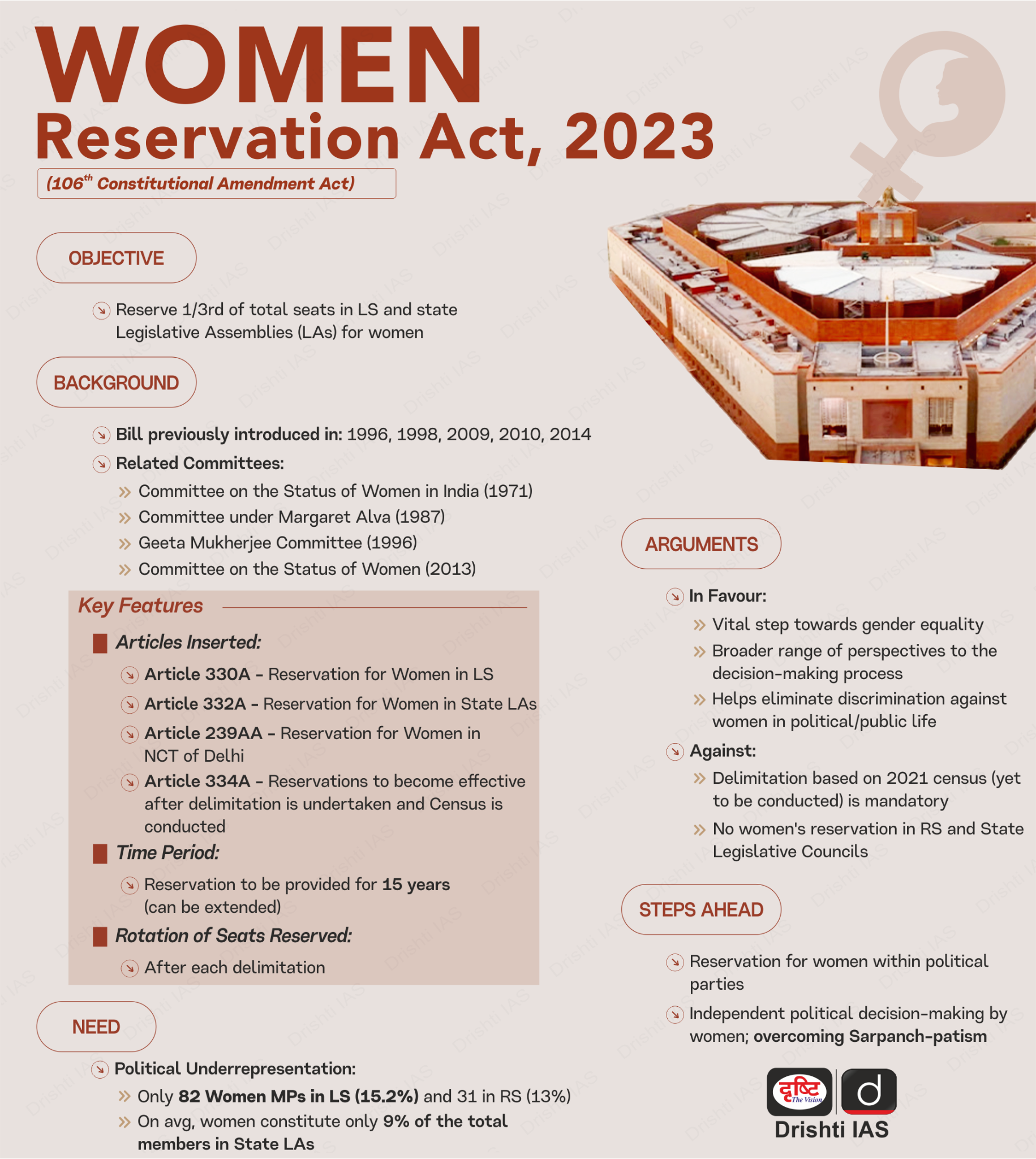
The Women’s Quota Act 2023, officially known as the Nari Shakti Vandan Adhiniyam, marks a pivotal moment in India’s commitment to women’s rights and gender equality. This landmark legislation aims to ensure that women play a substantial role in the political landscape by reserving seats for them in legislative bodies, a move that could significantly alter the electoral dynamics leading up to the 2029 general election. As the nation prepares for this progressive shift, the provisions of the Constitution (One Hundred and Sixth Amendment) Act 2023 are set to take effect, empowering women and promoting inclusivity in governance. By embracing women’s reservation, India takes a significant step toward rectifying historical imbalances and nurturing future generations of strong female leaders. The introduction of this constitutional amendment Bill is not merely a policy change; it symbolizes a broader movement toward equality and represents the voices of countless women across the nation.
The introduction of women’s reservation in India, specifically through the recent legislation known as the Women’s Quota Act 2023, has sparked significant discourse on gender equity in governance. This initiative, often referred to as the Nari Shakti Vandan Adhiniyam, endeavors to enhance female representation within political frameworks, thereby fostering a more inclusive democracy. As preparations advance for the upcoming 2029 general election, this act underscores the critical importance of amplifying women’s voices in decision-making processes. Emphasizing the urgency for such reforms, the Constitutional amendment Bill will reshape the political landscape, ensuring that women’s contributions are recognized and valued. In a country where progress in women’s rights has been a long-standing struggle, this legislative move embodies hope for a balanced and equitable future.
Understanding the Women’s Quota Act 2023
The Women’s Quota Act 2023, also known as the Nari Shakti Vandan Adhiniyam, represents a significant milestone in India’s legislative journey towards ensuring gender equality in political representation. The act mandates that 33% of all seats in the Lok Sabha and state legislative assemblies are reserved for women, thereby enhancing women’s participation in governance. This move is poised to bridge the gender gap in Indian politics, empowering women to take on leadership roles that have historically been dominated by men.
By implementing 33% reservation for women, this act not only aims to increase women’s representation but also addresses broader women’s rights issues in India. It encourages a more equitable political landscape where women’s voices and concerns can influence policy-making. The act is a foundational step towards achieving gender parity, opening the path for enhanced participation of women in the 2029 general election and beyond.
The Impact of the Nari Shakti Vandan Adhiniyam on Women’s Rights
The Nari Shakti Vandan Adhiniyam is set to have a transformative impact on women’s rights in India. The constitutional amendment reinforces the significance of women’s issues at the highest levels of governance, allowing for a more inclusive approach to policy formation that directly affects women’s lives. Advocates argue that this will encourage more women to enter public service and political life, fostering a new generation of female leaders who can champion women’s rights across various spheres.
Moreover, the act will create a ripple effect in society, inspiring other initiatives that promote women’s empowerment. It is expected to lead to improvements in areas such as education, health, and employment, as women who acquire political power will be motivated to address the systemic challenges that hinder female progress. The Nari Shakti Vandan Adhiniyam is not just about reservation; it symbolizes a broader commitment to the upliftment of women in India, setting a precedent that could serve as a model for other democracies.
Preparing for the 2029 General Election: Constitutional Amendment Bill Explained
As India gears up for the 2029 General Election, the implementation of the Constitutional Amendment Bill associated with the Women’s Quota Act 2023 is crucial. It details how women will be granted the reserved seats in various levels of governance, ensuring that their paths to political participation are clearly defined. The significance of this bill lies not only in its immediate effects but also in its long-term vision for women’s involvement in politics, making it a historic step for the nation.
In anticipation of the 2029 election, political parties are being encouraged to adopt strategies that actively promote female candidates. This push for women’s reservation is not only a legal requirement but also a moral imperative, reflecting India’s commitment to gender equality. It signifies an evolving political landscape where women’s contributions will be acknowledged and celebrated. Moreover, this proactive approach enhances the prospects for women, ensuring their rightful place in the democratic process.
Challenges and Opportunities Following the Women’s Quota Act
While the Women’s Quota Act 2023 heralds a new era for women in politics, it also poses certain challenges that must be addressed. One of the primary concerns is the effective implementation of women’s reservation across all states and levels of government. There is a need for robust mechanisms that ensure compliance and transparency in the allotment of reserved seats, alongside measures to combat potential backlash against women candidates. Organizations, civil society, and the government must work collectively to create an environment conducive to women’s political participation.
On the flip side, this act opens up numerous opportunities for nurturing female leadership and enhancing their capabilities through targeted training and development programs. Encouraging more women to engage in the political process will likely lead to varied perspectives in governance that prioritize women’s issues. As women gain prominence in political roles, the potential for transformative policies that uplift marginalized communities increases, thereby reinforcing the commitment to women’s rights and broader social justice initiatives.
The Role of Women’s Reservation in Strengthening Democracy
The introduction of the Women’s Quota Act 2023 is a pivotal moment for democracy in India. By ensuring women have a formal role in the political sphere, it addresses a critical imbalance in representation, ultimately strengthening democratic principles. Representation is a cornerstone of democracy, and inclusive governance leads to more comprehensive policy-making that considers the needs and aspirations of the entire population, not just one gender.
Furthermore, the act is a significant step towards fostering a culture of participation and civic engagement among women. Women in leadership roles can influence legislation that prioritizes health, education, and economic empowerment, thereby catalyzing societal change. This push for women’s reservation is celebrated as a reaffirmation of democratic values while paving the way for a future where women’s rights are truly honored and implemented.
Future Implications of the Women’s Quota Act for Indian Society
The Women’s Quota Act 2023 not only projects immediate changes in political representation but also promises long-term transformations in Indian society. As women increasingly occupy political positions, the representation of women’s voices in social policies is expected to improve significantly. This can promote gender-sensitive policies that address issues like domestic violence, health care access, and economic disparities, contributing to a more equitable society.
Moreover, as women step into these empowered roles, there could be a shift in traditional norms and stereotypes that have often limited women’s autonomy. The act has the potential to inspire a cultural shift that encourages young girls to aspire toward leadership and public service. In essence, the Women’s Quota Act 2023 could signal a renaissance of sorts for women’s rights in India, fostering a generation that champions equality, empowerment, and active civic engagement.
Public Reaction and Support for Women’s Quota Legislation
Public reception to the Women’s Quota Act 2023 has been largely positive, as citizens and activists recognize its significance in advancing women’s rights in India. Various women’s organizations, NGOs, and activists have voiced their support, emphasizing that this legislative change empowers women and promotes gender equality in governance. This act is perceived as an answer to years of advocacy for women’s reservation, reflecting society’s desire for inclusive representation.
However, there are also voices of opposition that raise concerns about tokenism and the true effectiveness of such quotas in creating meaningful change. It is essential for proponents of the Act to engage these concerns constructively, ensuring that the implementation of the act translates not only to numerical representation but also to genuine empowerment and influence in decision-making processes. The ongoing discourse on the Women’s Quota Act will play a crucial role in shaping its legacy and impact in the years to come.
Transformational Effects of Women’s Quota on Political Parties
The implementation of the Women’s Quota Act 2023 is anticipated to transform the strategies adopted by political parties in India. With a legal mandate for reserving seats for women, parties will need to rethink their candidate selection processes, fostering an environment where women are prioritized on ticket distributions. This shift could lead to greater female representation across the political spectrum, reflecting a more balanced approach to governance.
Moreover, parties that embrace this change are likely to resonate more with a growing electorate that values gender equality. By supporting the candidacy of women, political parties can enhance their credibility and connect with the aspirations of women voters, ultimately impacting electoral outcomes. This legislative change could rejuvenate party dynamics, fostering a more inclusive and equitable political ecosystem that benefits both men and women.
A Historical Context: Women’s Reservation in India
The journey towards women’s reservation in India has been long and fraught with challenges, culminating in the Women’s Quota Act 2023. Reflecting on past efforts, one can see numerous proposals and discussions, but it was the persistent advocacy from women’s rights organizations that kept the issue alive in the policy discourse. The enactment of the Nari Shakti Vandan Adhiniyam marks not only a legislative victory but also a societal recognition of the need for women’s representation in governance.
The women’s reservation debate has placed India on a global map concerning women’s rights, attracting attention from various international entities advocating for gender equality. This historical context amplifies the significance of the current act, positioning it as a step towards aligning with global standards of democratic representation. As India moves forward, the Women’s Quota Act serves as a reminder of the progress made and the road still ahead in the fight for women’s rights.
Frequently Asked Questions
What is the Women’s Quota Act 2023 and how does it relate to women’s reservation in India?
The Women’s Quota Act 2023, formally known as the Nari Shakti Vandan Adhiniyam, is a Constitutional amendment aimed at reserving one-third of the seats in the Lok Sabha and state legislative assemblies for women. This landmark legislation, set to take effect on April 16, 2026, is a significant step towards advancing women’s rights in India and promoting gender equality in political representation. It is intended to facilitate women’s participation in the democratic process leading up to the 2029 general election.
| Key Points |
|---|
| The Women’s Quota Act of 2023 becomes effective on April 16, 2026. |
| This act aims to reserve seats for women in the Lok Sabha and State Assemblies. |
| The act is part of a broader legislative effort leading to the 2029 general elections. |
| The Constitutional amendment is referred to as the Nari Shakti Vandan Adhiniyam. |
| Bharti Jain, a seasoned journalist, reported on this significant legislative change. |
Summary
The Women’s Quota Act 2023 represents a monumental shift in Indian politics and governance, making it a crucial step towards gender equality. This legislation promises to empower women by ensuring their representation in legislative bodies at both national and state levels. With the official activation on April 16, 2026, and the anticipation of seats reserved specifically for women, this act aims to pave the way for inclusive governance ahead of the 2029 general elections. The Nari Shakti Vandan Adhiniyam seeks to elevate the voices of women in decision-making processes, signifying a progressive step towards achieving parity in Indian society.