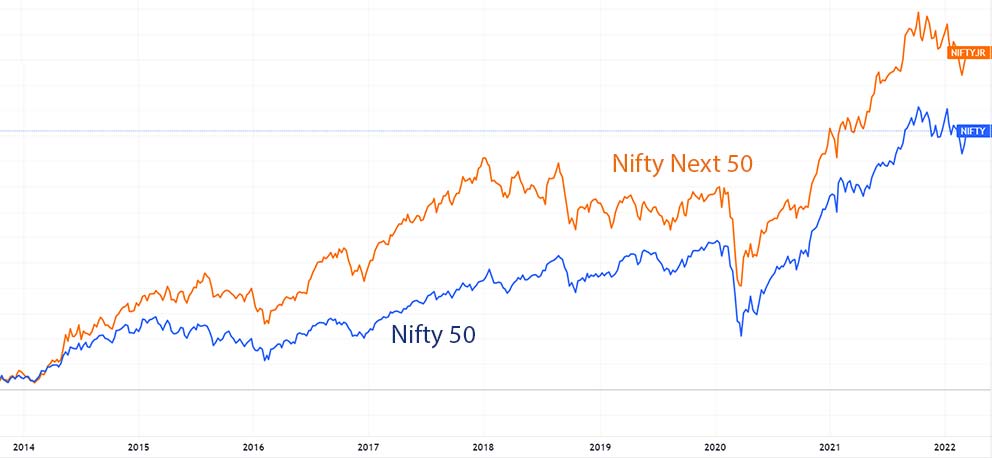
Nifty Next 50 Funds present an exciting investment opportunity for those looking to diversify their portfolio beyond the traditional Nifty 50 index. As these funds track emerging large-cap companies, they have gained traction among retail investors. When considering a monthly SIP investment, it’s crucial to compare the performance of different funds, such as UTI, SBI, and ICICI Nifty Next 50, over the past three years. Insights from their SIP performance reveal that even a minor difference in returns can significantly impact your corpus over time. This article will delve into these variations, helping investors understand the best choices for their financial goals.
The Nifty Next 50 index funds represent a fascinating segment of mutual fund investments that target large-cap companies poised for future growth. Known for their potential in delivering substantial returns, these funds have attracted considerable attention among investors interested in options beyond the Nifty 50. By analyzing monthly systematic investment plans (SIPs) across various schemes such as UTI, SBI, and ICICI, one can discern the nuances of their performance. Moreover, this exploration will shed light on how slight fluctuations in annual returns can compound over the years, ultimately affecting an investor’s overall wealth. This discussion aims to equip investors with critical insights on selecting the right Nifty Next 50 index fund to align with their investment strategy.
Introduction to Nifty Next 50 Funds
Nifty Next 50 funds are increasingly becoming a popular choice among investors who are looking to diversify their portfolio beyond the well-established Nifty 50 index. This index includes the next 50 companies in line after Nifty 50 in terms of free-float market capitalization, providing a unique opportunity for investors to tap into potentially high-growth businesses. It is essential for investors to understand the nuances of these funds, particularly how different fund houses can impact performance, especially with monthly SIP investments.
Investing in a Nifty Next 50 fund allows individuals to gain exposure to mid-cap and emerging large-cap stocks, which have the potential to become Nifty 50 constituents in the future. Over time, such investments can yield significant returns as these companies grow and expand in their respective markets. As interest in Nifty Next 50 funds continues to rise, understanding the performance metrics, especially SIP returns, becomes crucial for informed decision-making.
SIP Performance of UTI vs SBI vs ICICI
When comparing SIP performance across various Nifty Next 50 funds, UTI and SBI have emerged as leaders over a three-year period. For example, both funds turned a ₹1.8 lakh investment into over ₹2.13 lakh, showcasing their strong ability to generate returns on a monthly SIP investment of ₹5,000. This impressive growth reflects not only the strong alignment with the Nifty Next 50 index but also effective fund management strategies employed by these fund houses.
In contrast, while ICICI Prudential Nifty Next 50 Index Fund has also shown commendable performance, its journey has been on a slightly different trajectory. With a longer track record dating back to 2010, it regularly competes within the category but consistently manages to attract a larger share of assets under management (AUM). Nevertheless, potential investors need to consider various factors, including tracking errors and expense ratios, which can contribute to differences in performance even for funds tracking the same index.
The Importance of Tracking Error in Fund Performance
Tracking error is a crucial concept when investing in index funds, including the Nifty Next 50 funds. It refers to the variation between the performance of the fund and that of its benchmark index. Low tracking error indicates that the fund’s returns closely mirror those of the Nifty Next 50 index, while a high tracking error suggests inefficiencies in fund management. Understanding tracking error can help investors gauge which funds may be more reliable choices for long-term investments through systematic investment plans (SIPs).
For example, if an investor chooses between funds such as UTI and SBI based solely on their past performance without considering tracking error, they may be misled. Variations in returns due to tracking error can impact how much an investor actually earns over time. Therefore, examining these metrics not only informs investment decisions but also helps in building a more robust portfolio.
Expense Ratios: Evaluating Fund Efficiency
Expense ratios significantly affect the net returns that investors receive from their Nifty Next 50 investments. They represent the annual costs associated with managing the fund and are expressed as a percentage of the fund’s assets. A lower expense ratio generally indicates higher potential net returns for investors, especially in the case of systematic investment plans, where fees can eat into overall gains over time.
As investors compare Nifty Next 50 funds, understanding the expense ratios of UTI, SBI, and ICICI is vital. For instance, while the monthly SIP investment may seem advantageous, high fees can limit the benefits, especially if one fund outperforms another by a narrow margin. Evaluating expense ratios along with other performance metrics helps investors make informed decisions about which fund to choose based on their investment goals.
Comparative Analysis of Fund Management Styles
The differences in fund management styles between UTI, SBI, and ICICI contribute to variations in performance despite all of them tracking the Nifty Next 50 index. UTI and SBI have demonstrated more aggressive investment strategies that capitalize on emerging market trends while balancing their risk exposure. This comparative aggressiveness may explain their superior performance in terms of 3-year SIP returns, as noted in recent analyses.
In contrast, ICICI Prudential has maintained a steadier approach that prioritizes consistency over high-risk returns, which may lead to better performance over longer horizons. This variance suggests that investors need to align fund choice with their personal risk tolerance and financial objectives, especially when considering a monthly SIP investment in Nifty Next 50 funds.
The Growth of Nifty Next 50 Funds in the Market
With an increasing trend of retail investors seeking alternative avenues for diversification, Nifty Next 50 funds have gained significant traction in the mutual fund landscape. These funds offer exposure to a carefully curated selection of emerging large-cap companies, which are on the cusp of becoming the next Nifty 50 constituents. The growing interest reflects a shift in investor sentiment towards long-term wealth creation through systematic investment plans.
Furthermore, as more funds enter this category, competition will likely drive down expense ratios and boost performance standards, benefiting retail investors. Understanding the market dynamics and the potential for Nifty Next 50 funds can offer retail investors an edge in building a resilient investment portfolio.
Assessing Returns Over Varying Time Horizons
Time is a critical factor when assessing the performance of Nifty Next 50 funds, especially for investors opting for a monthly SIP. Analyzing returns over different time periods, such as 1 year versus 3 years, reveals valuable insights into fund stability and growth potential. For investors, focusing on long-term trends can provide greater confidence in their investment strategy, as short-term fluctuations may distort the overall picture.
For instance, when comparing UTI and SBI funds over a 3-year horizon, both have shown remarkable resilience and return consistency. This kind of performance stability becomes increasingly important for individuals relying on SIP investments as they aspire to build a substantial corpus over time.
Investing in Emerging Large-Caps: Opportunities Ahead
Investing in Nifty Next 50 funds opens doors to a wealth of opportunities, particularly within the context of emerging large-cap companies. These companies, which are often less known compared to their Nifty 50 counterparts, possess significant growth potential. As they expand their market presence, any investment made today could yield considerable returns in the future, making them appealing to both conservative and aggressive investors.
Moreover, the recent surge in interest towards the Nifty Next 50 index illustrates a broader market trend where investors are increasingly willing to explore high-growth sectors. By strategically choosing funds that focus on these companies through regular SIPs, investors can capitalize on this potential and enhance their overall portfolio performance.
Conclusion: Choosing the Right Nifty Next 50 Fund
Selecting the appropriate Nifty Next 50 fund hinges on various factors, including individual risk tolerance, investment goals, and analysis of key metrics like performance and expense ratios. With UTI, SBI, and ICICI emerging as strong contenders, investors must delve into each fund’s management strategy and historical performance to make an educated choice. A well-informed decision can significantly enhance the outcomes of systematic investment plans.
Ultimately, the growing popularity of Nifty Next 50 funds underscores the importance of education and awareness among investors. By equipping themselves with the right knowledge, individuals can navigate the complexities of mutual funds and make strategic investment choices that align with their long-term financial objectives.
Frequently Asked Questions
What is the performance of UTI and SBI funds in Nifty Next 50 index over a 3-year SIP period?
UTI and SBI Nifty Next 50 index funds have shown exceptional performance in the 3-year SIP period, turning an investment of ₹1.8 lakh into over ₹2.13 lakh. They are among the top-performing funds compared in this category.
How does ICICI Nifty Next 50 index fund compare in SIP returns with UTI and SBI?
The ICICI Nifty Next 50 index fund has delivered a 3-year return of 21.29%, which is competitive, though it slightly trails behind UTI and SBI funds, which have consistently performed better over the same period.
What factors cause differences in monthly SIP investment returns among Nifty Next 50 funds?
Differences in returns among Nifty Next 50 funds can arise from various factors like tracking error, varying expense ratios, cash allocation differences, and the efficiency of portfolio rebalancing.
Why should investors consider a monthly SIP in Nifty Next 50 index funds?
Investing through a monthly SIP in Nifty Next 50 index funds allows investors to gain exposure to emerging large-cap companies beyond the traditional Nifty 50, potentially leading to significant corpus growth over time.
How does the Nifty Next 50 index impact the performance of these funds?
The Nifty Next 50 index serves as the benchmark for these funds, encompassing companies that are poised to become part of the Nifty 50. Variances in fund management and allocation can influence how closely a fund tracks the index’s performance.
What is the significance of expense ratios in Nifty Next 50 funds like UTI and SBI?
Expense ratios are crucial as they directly reduce the returns on investment in Nifty Next 50 funds. Lower expense ratios generally favor higher net returns for investors, making UTI and SBI funds more attractive among their peers.
How do newer Nifty Next 50 funds compare in performance to older funds?
Newer Nifty Next 50 funds may not have a long track record for comparison, and although they track the same index, their initial performance can differ due to varying management strategies and market conditions.
What is the average return for a ₹5,000 monthly SIP in Nifty Next 50 funds over 3 years?
A ₹5,000 monthly SIP in Nifty Next 50 funds over three years typically yields returns of around 21%, depending on the specific fund chosen, with UTI and SBI being notable leaders in this performance metric.
Can investing in Nifty Next 50 index funds through SIP mitigate risks?
Yes, by investing through a monthly SIP in Nifty Next 50 index funds, investors can mitigate risks through dollar-cost averaging, which helps reduce the impact of market volatility over time.
What should I consider when choosing between UTI, SBI, and ICICI Nifty Next 50 index funds?
When comparing UTI, SBI, and ICICI Nifty Next 50 index funds, consider factors like historical performance, expense ratios, fund management, and how closely each fund tracks the Nifty Next 50 index to determine the best fit for your investment goals.
| Fund | Launch Date | Fund Manager | AUM (₹ Cr) | NAV (₹) | 1Y Return (%) | 3Y Return (%) | 5Y Return (%) | Since Inception (%) |
|---|---|---|---|---|---|---|---|---|
| HDFC Nifty Next 50 Index Fund | 03-Nov-2021 | Arun Agarwal | 1,993.71 | 16.60 | 12.61 | 21.16 | NA | 11.93 |
| ICICI Pru Nifty Next 50 Index Fund | 25-Jun-2010 | Nishit Patel | 7,604.43 | 63.00 | 12.57 | 21.29 | 14.95 | 12.29 |
| Motilal Oswal Nifty Next 50 Fund | 23-Dec-2019 | Swapnil P. Mayekar | 380.90 | 24.61 | 12.25 | 21.02 | 14.67 | 15.18 |
| SBI Nifty Next 50 Index Fund | 19-May-2021 | Viral Chhadva | 1,711.40 | 19.39 | 12.61 | 21.31 | NA | 14.26 |
| UTI Nifty Next 50 Index Fund | 28-Jun-2018 | Sharwan Kumar Goyal | 6,560.80 | 25.54 | 12.61 | 21.35 | 14.99 | 12.67 |
Summary
Nifty Next 50 Funds have become increasingly popular among investors seeking a diverse range of large-cap stocks beyond the Nifty 50 index. By systematically investing ₹5,000 monthly into these funds over three years, it is evident that UTI and SBI have outperformed their peers in terms of returns. Despite all funds tracking the same benchmark, the differences in returns can be attributed to various factors including expense ratios and portfolio management efficiency. Investors must consider these factors carefully when choosing which fund to invest in for maximizing their returns.